AI Prompt Templates for Business Operations That Teams Can Actually Use
1 hour ago
Most businesses do not struggle with AI because the tools are too advanced. They struggle because the use case is unclear.
A founder asks AI to “improve sales.” A manager asks it to “make this better.” A team member copies a prompt from the internet, pastes it into a tool, and expects something useful to happen. When the output feels generic or disconnected from reality, the conclusion is simple: AI does not work for the business.
But that is rarely the real issue.
In most cases, AI becomes useful only when a business stops treating it like magic and starts treating it as a structured business tool. That means knowing where it fits into day-to-day work, where it does not, and how to create repeatable instructions that save time without reducing the quality of thinking.
That is where AI prompt templates for business become genuinely useful. They help teams move away from random experimentation and toward repeatable workflows that support reporting, planning, communication, and execution.
In the first part, we showed how to structure a prompt, and in this, we want to teach MSMEs which of their business processes need AI and which don’t.
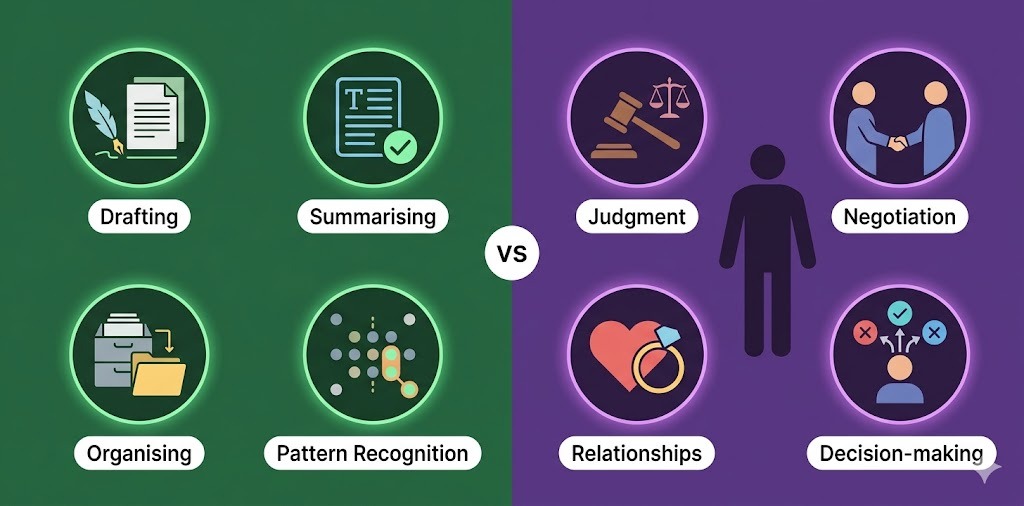
Not Every Business Task Needs AI
Before building templates, it helps to understand one thing clearly. Not every business task should be handed to AI.
AI performs best when the task involves drafting, summarising, comparing, organising, restructuring, or identifying patterns in existing information. It struggles when the task depends heavily on judgment, human relationships, negotiation, or final decision-making.
For example, AI can help summarise a sales review meeting. It can organise discussion points, identify repeated concerns, and turn messy notes into action items. But it should not be the final authority on whether a salesperson is underperforming, whether a client relationship is weakening, or whether a pricing decision makes sense.
That distinction matters because many businesses mistake AI for replacing thinking rather than supporting execution.
The smartest business use of AI is usually not dramatic. It is practical. It reduces repetition, speeds up documentation, and improves clarity in places where teams would otherwise lose time.
Where AI Helps in Business Operations
If you are trying to apply AI sensibly, the best place to start is with tasks that happen repeatedly and already follow a predictable structure.
- Internal reporting is one of the strongest examples. Most teams already review numbers, discuss what changed, and identify next steps. AI can help convert raw notes or spreadsheets into structured summaries that are easier to read and act on.
- Meeting summaries are another natural fit. In many businesses, the meeting is not the problem. The problem is what happens after the meeting. Decisions are not documented properly, action items get lost, and follow-ups become dependent on memory. AI can take rough meeting notes and turn them into a clean summary with owners, deadlines, and next actions.
- Sales support is another area where AI works well. It can help draft follow-up emails, organise objections raised during calls, or summarise lead conversations into concise notes for the next person in the pipeline.
- Customer support can also benefit. AI can help structure response drafts, create FAQ summaries, or turn repeated customer complaints into patterns the team should address operationally.
- Marketing teams can use AI to organise content ideas, simplify complex material, repurpose one core asset into multiple formats, or structure campaign planning documents.
- Operations teams can use it to draft SOPs, clean up handover instructions, and simplify messy processes into task-based workflows.
This is where AI for business operations becomes practical. It supports recurring work that already exists instead of forcing businesses to invent artificial use cases.
Why Reusable Prompt Templates Matter
The problem with one-off prompting is inconsistency.
One team member gets a useful answer because they know how to write a good prompt. Another gets a poor result because their prompt is vague. A third gets something half-useful, but the output format changes every time, so no one can actually use it consistently.
That is why templates matter.
Reusable prompts create consistency across recurring tasks. They reduce dependence on individual prompting skills and make AI easier to adopt across teams. Instead of starting from scratch every time, the team uses a prompt structure that already includes the right role, business context, constraints, and output format.
That is the real value of prompt engineering for business. It is not about writing prompts that sound clever. It is about making work more repeatable, more usable, and easier to review.
A good template should usually define five things clearly: who the AI is acting as, what business context it should consider, what exact task needs to be done, what it should avoid, and how the output should be structured.
When these elements remain consistent, the output becomes easier to trust and use.
What Makes a Prompt Template Actually Reusable
A reusable prompt is not just a long prompt. It is a prompt that can be reused with minor changes to the inputs.
That means the core structure should stay stable even when the situation changes. For example, a monthly performance review template should still work whether the business is discussing sales, leads, retention, or operating costs. A follow-up email template should still work whether the lead is warm, hesitant, or comparing vendors.
The goal is not to write one perfect prompt. The goal is to build a usable framework that helps the team work faster without becoming careless.
A reusable template usually includes a fixed instruction layer and a variable input layer. The fixed layer explains the role, tone, approach, and output format. The variable layer includes the actual data, notes, numbers, meeting details, or customer information for that specific case.
Once teams understand that structure, AI prompt templates for business become much easier to build and scale within real workflows.
_cleanup_1776427590.jpeg)
5 AI Prompt Templates Businesses Can Start Using
1. Monthly Performance Summary Template
This is useful for founders, managers, and team leads who want a quick business review without spending an hour organising raw data.
Prompt Template:
You are acting as a business advisor reviewing monthly performance for an Indian SME. Review the following data on sales, leads, conversions, repeat customers, and operating costs. Identify what changed compared to last month, what may have caused the change, and what needs attention next. Avoid jargon, generic advice, and recommendations to hire or use expensive tools. Present the output as a one-page summary with three sections: key shifts, likely reasons, and top three priorities for the next month.
Why it works:
This helps teams move from raw numbers to a useful direction. It also prevents AI from giving broad strategy language that sounds impressive but does not help anyone act.
2. Sales Follow-Up Draft Template
This works well for businesses where follow-up consistency affects conversions.
Prompt Template:
You are acting as a sales support assistant for a service-based business. Based on the following sales call notes, draft a professional follow-up email. The prospect is interested but undecided. Keep the tone warm, clear, and confident. Do not sound pushy. Mention the client’s main concern, recap the business need discussed, and suggest a clear next step. Keep the email under 180 words.
Why it works:
The template gives structure without making every sales email sound robotic. It also saves time after calls and helps the team stay consistent.
3. Meeting Notes to Action Summary Template
This is one of the easiest and most valuable use cases for teams.
Prompt Template:
You are acting as an operations coordinator. Convert the following meeting notes into a structured action summary. Highlight the main decisions made, unresolved issues, action items, owners, and expected timelines. Do not include unnecessary background. Use simple business language and keep the format clean enough to send directly to the team.
Why it works:
It reduces confusion after meetings and improves accountability without requiring someone to manually clean up messy notes.
4. Customer Complaint Response Draft Template
This is useful when teams need consistency and empathy in written communication.
Prompt Template:
You are acting as a customer success lead for a growing business. Draft a response to the following customer complaint. The tone should be calm, professional, and empathetic. Acknowledge the issue clearly, avoid sounding defensive, and explain the next step we are taking. Do not overpromise. Keep the response human and under 200 words.
Why it works:
It helps teams respond faster while protecting brand tone and reducing emotionally reactive replies.
5. SOP Drafting Template
This works especially well for businesses trying to reduce dependency on verbal instructions.
Prompt Template:
You are acting as an operations manager creating an SOP for a small business team. Based on the following process notes, create a clear step-by-step SOP that a new team member can follow without supervision. Use simple language. Include purpose, steps, checkpoints, common mistakes, and expected outcome. Avoid corporate jargon and do not assume prior knowledge.
Why it works:
This helps businesses convert verbal knowledge into usable documentation, which is often where growth starts getting messy.
These are the kinds of workflows where AI productivity for teams becomes visible. The gain is not just speed. It is consistency, clarity, and reduced rework.
Where Human Review Still Matters
Even strong templates do not remove the need for review.
AI should not send the final customer response without someone checking tone and accuracy. It should not produce leadership summaries unless someone confirms that the interpretation of the numbers makes sense. It should not create SOPs without the people doing the actual work verifying that the steps reflect reality.
This is where many businesses get it wrong.
They either distrust AI completely or they trust it too quickly. Neither approach is useful. A better model is simple. Let AI handle the heavy lifting in structure, drafting, and formatting. Let people handle judgment, nuance, accountability, and approval.
That is what keeps the system practical.
Start Small Before You Scale
Businesses do not need twenty templates on day one. They usually need three.
Start with the tasks that happen most often and consume the most avoidable time. That could be reporting, follow-up emails, meeting summaries, or documentation. Once the team sees value there, it becomes easier to build more structured use cases.
The mistake is trying to “implement AI” across the whole business in one sweep. That usually creates confusion, inconsistent usage, and disappointing results.
A better approach is to identify recurring workflows, build templates around them, test them under real-world conditions, and improve them over time.
That is how AI becomes operationally useful instead of just interesting.
If your business is already using AI in scattered ways, this is the right time to stop experimenting randomly and start building repeatable systems around the work that matters.
How Skillwise Solutions Approaches AI as a Business Execution Tool
At Skillwise Solutions, we do not see AI as a shortcut for business growth or a replacement for clear thinking. We see it as a tool that is useful only when embedded in stronger business processes.
Most businesses do not fail because of AI; the tools are not weak. They fail because the workflow around the tool is unclear. The task is vague, the inputs are incomplete, the review process is missing, and the output is expected to solve problems that were never properly defined in the first place.
That is why our approach is rooted in business execution. Before AI can improve anything, the business needs clarity around what is being solved, who is responsible, what constraints matter, and what kind of output is actually useful. Without that structure, even the best AI tools create more noise than value.
Skillwise Solutions looks at AI through the lens of real business applications. That includes how teams report information, how decisions are documented, how internal communication flows, and how repeatable work can be made more efficient without sacrificing judgment and accountability.
In that sense, AI is not the strategy by itself. It is one part of a better execution system. When used properly, it can help businesses reduce rework, improve clarity, speed up routine tasks, and strengthen day-to-day operational discipline.
The goal is not to make businesses rely on AI for everything. The goal is to help businesses use it where it actually improves performance. That is the difference between using AI casually and using it as a business execution tool.