


The First 30 Days of Digital Marketing for an MSME: What Actually Matters
2 weeks ago
Most MSME owners do not struggle with effort. They struggle with direction.
In the first 30 days of starting or fixing your digital presence, what you prioritise matters far more than how much you do. Many businesses jump into posting content, running ads, or hiring agencies without a clear plan. The result is confusion, wasted budgets, and inconsistent growth. A strong digital marketing strategy for MSMEs is not about doing everything. It is about doing the right things in the right order.
If you are trying to build your digital presence from scratch or fix what is not working, this guide will give you a clear starting point. If you want a structured roadmap tailored to your business, explore our services or get in touch with us.
Who This Is For (And Why It Matters Now)
This guide is designed for three key groups. It is for MSME owners who want to generate leads but are unsure where to begin. It is for learners who want to understand how digital marketing works in real business scenarios. It is also for experts who want to move beyond random execution and apply structured thinking.
In the Indian MSME ecosystem, a common pattern is visible. Businesses invest in digital marketing without building a strong base. They focus on visibility before clarity, and on activity before strategy. A well-defined digital marketing strategy for MSMEs ensures that every action is tied to a business outcome, not just online presence.
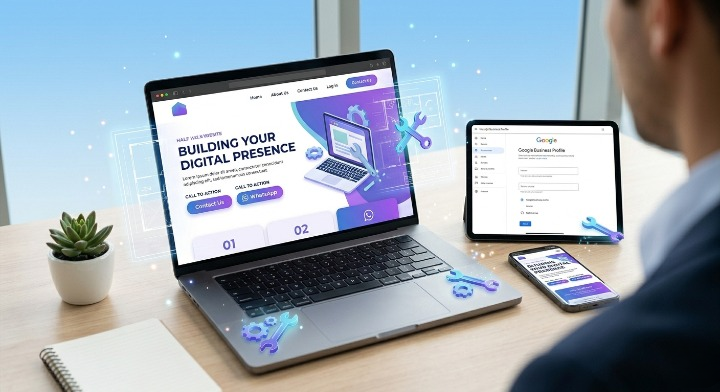
Week 1: Fix Your Digital Foundation First
Before you think about traffic, you need to fix what people experience when they land on your brand. Most MSMEs lose potential customers not because people are not visiting, but because visitors do not understand what the business offers or what to do next. This is where your first week should be spent.
Focus on building clarity and trust across your digital touchpoints. Your messaging should immediately communicate what you do and who you serve. Each page on your website should have one clear objective, whether it is generating enquiries, bookings, or direct calls. Calls to action must be visible and easy to act on, especially through mobile-friendly formats like WhatsApp.
To get this right, prioritise the following:
- Clear and simple messaging that can be understood within a few seconds
- One focused goal per page instead of multiple distractions
- Strong calls to action such as “Contact Us,” “Get a Quote,” or WhatsApp
- Mobile optimisation to match Indian user behaviour
These are foundational digital marketing tips for small businesses that directly impact whether your traffic converts or drops off. Without this base, every other effort will struggle to deliver results.
Week 2: Build Visibility Where It Actually Matters
Once your foundation is ready, the next step is visibility. However, visibility does not mean being present everywhere. Many MSMEs try to manage multiple platforms at once, which leads to inconsistency and diluted messaging.
A smarter approach is to focus on one or two platforms your audience already spends time on. For most Indian MSMEs, this includes Google Search and Google Business Profile for intent-driven discovery, along with either Instagram or LinkedIn, depending on the business.
At this stage, your digital marketing strategy plan should focus on consistency and relevance. Instead of chasing trends, focus on being discoverable and understandable.
Key actions to prioritise include:
- Setting up and optimising your Google Business Profile with accurate details
- Posting content that clearly explains your offerings and builds trust
- Using simple, searchable language that matches customer intent
- Ensuring that every platform makes it easy for users to contact you
These are practical digital marketing tips for beginners that help you build steady visibility. Growth at this stage is not about going viral. It is about being found by the right people at the right time.
Week 3: Start Tracking What Actually Works
By the third week, your focus should shift from doing to understanding. If you are not tracking performance, you are relying on guesswork. Many MSMEs either ignore tracking completely or get overwhelmed by too much data.
The goal here is to keep tracking simple and useful. You need to understand what is working so you can do more of it.
Start by setting up basic systems such as Google Analytics for website insights, lead tracking through forms or WhatsApp, and platform analytics from Instagram or LinkedIn. Once this is in place, focus on answering a few key questions.
- Where is your traffic coming from?
- What actions are users taking on your website or profile?
- At what point are users dropping off before converting?
A strong digital marketing strategy for your MSME evolves through these insights. Instead of guessing your next move, you begin to make decisions based on actual behaviour.
Week 4: Optimise What Is Already Working
At this stage, many businesses feel the need to change everything. This is often where momentum is lost. The first 30 days are not about constant reinvention. They are about refining what is already showing potential.
Instead of starting from scratch, focus on optimisation. Look at what is working and build on it. If a certain type of content is generating engagement or enquiries, create more of it. If your landing page is getting traffic but not converting, improve clarity, structure, or calls to action.
Focus on the following:
- Double down on content and channels that are performing well
- Improve landing pages that attract visitors but fail to convert
- Fix specific drop-off points instead of redesigning everything
- Strengthen calls to action based on user behaviour
This is where your digital marketing strategy plan becomes sharper and more efficient. Consistent improvements lead to stronger results over time.
What Most MSMEs Get Wrong in the First 30 Days
Understanding what not to do is just as important as knowing what to do. Many MSMEs make similar mistakes in their early stages, which slows down their progress.
Common issues include running ads without a clear landing page, posting content without a defined audience, trying to be present on every platform at once, and expecting immediate results. These decisions are often driven by urgency rather than strategy.
Following the above-mentioned structured digital marketing tips for small businesses helps avoid these pitfalls. When you focus on clarity, consistency, and measurable actions, your efforts begin to compound instead of reset.
Why Skillwise Solutions Helps You Get This Right Faster
Most MSMEs do not lack effort. They lack clarity and a structured way to execute.
Skillwise Solutions brings together businesses, learners, and experts into a single ecosystem where real challenges are solved through practical execution. The approach is built on actual market needs, not generic frameworks. This ensures that your digital marketing strategy for MSMEs is grounded in reality and aligned with business outcomes.
For MSME owners, this means knowing exactly what to prioritise and how to move forward without wasting time or budget. Instead of experimenting blindly or following scattered advice, you get a clear, structured path that focuses on results.
If you are ready to move from confusion to clarity and build a system that actually works, this is where you start. Get in touch with us or explore our services to build a digital marketing strategy tailored to your business.