How We Onboard MSMEs: From First Consultation to Digital Clarity
2 hours ago
For many MSME owners, digital marketing begins with confusion. One person says you need more reels. Another says your website needs a redesign. Someone else suggests ads, SEO, WhatsApp campaigns, or LinkedIn posting. Suddenly, what was supposed to help your business grow starts feeling like another problem to manage.
This is why onboarding matters.
At Skillwise Solutions, we do not begin with posting, designing, or advertising. We begin with understanding. Before creating a digital plan, we study where your business stands, what your audience needs, and what is stopping your brand from being seen, trusted, and remembered.
A good approach to digital marketing for MSMEs does not start with noise. It starts with clarity.
If you are an MSME owner trying to understand what your business actually needs online, get in touch with us or explore our services to begin with a structured consultation.
Why MSMEs Need Digital Clarity Before Digital Activity?
Most small businesses are not invisible because they are inactive. Many are already posting on social media, running occasional ads, maintaining a website, and sharing updates on WhatsApp. The problem is that these activities often happen without a clear direction.
For example, a coaching institute in Mumbai may post regularly on Instagram but have no proper enquiry flow. A B2B supplier in Pune may have a decent website but unclear service pages. A local service provider in Thane may run ads but direct visitors to a page that does not clearly explain the offer.
This is where digital clarity becomes important. Before spending money on campaigns, an MSME needs to know what is working, what is missing, and what must be fixed first. A strong MSME digital marketing strategy helps connect every digital action to a business goal.
Step 1: Consultation
The first step in our onboarding process is consultation. This is where we dive deep into your business goals, current challenges, target audience, and existing digital presence.
We do not treat every MSME the same. A retail brand, a professional service provider, a manufacturer, a coaching institute, and a local consultant will all need different strategies. The consultation helps us understand your business DNA before recommending any solution.
During this stage, we look at questions such as:
- What does your business offer, and who is it meant for?
- What kind of customers are you trying to attract?
- Where are your current leads coming from?
- What platforms are you already using?
- What has worked for you so far, and what has failed?
- What is the biggest digital bottleneck right now?
This step prevents random execution. Instead of assuming that every business needs the same package, we identify what your brand actually needs to move forward.
For MSMEs, this is especially important because budgets, time, and internal resources are limited. Every decision must be made carefully. That is why good digital marketing services for small businesses should always begin with listening before execution.
Step 2: Roadmap
Once we understand your business, we move into roadmap creation. This is where the strategy starts taking shape.
For social media, this means creating a clear narrative and engagement plan for your niche. The goal is not just to post regularly. The goal is to move your brand from invisible to influential in a way that feels relevant to your audience.
For website development, the roadmap includes understanding your user journey, identifying the pages you need, and deciding how your website should guide visitors towards action.
At this stage, we define:
- The core message your brand should communicate
- The platforms that deserve attention
- The type of content that should be created
- The role your website must play in conversion
- The customer journey from discovery to enquiry
- The practical timeline for execution
A roadmap gives direction to your digital presence. It ensures that your social media, website, content, and campaigns are not working in isolation.
This is where digital marketing for MSMEs becomes more structured. Instead of chasing trends, your business starts building a system.
Step 3: Gap Identification
Before building anything new, we identify what is currently blocking growth.
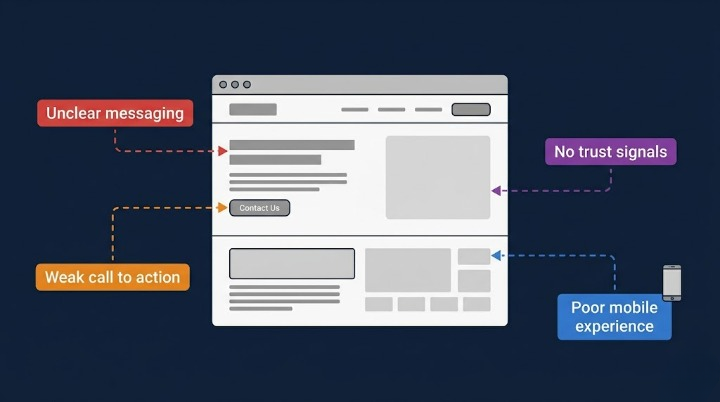
Sometimes the problem is not visibility. The problem is trust. Sometimes the website is getting traffic, but the enquiry button is hidden. Sometimes the Instagram page looks active, but the content does not explain why someone should choose the business. Sometimes the brand has good services, but the digital presence looks outdated.
Gap identification helps us pinpoint the exact friction points.
These gaps may include:
- Unclear messaging on the website or social media
- Weak calls to action
- Poor mobile experience
- Inconsistent branding
- Missing service pages
- Lack of proof, such as testimonials or case studies
- No proper lead capture system
- Content that does not match the buyer’s intent
For Indian MSMEs, these gaps can quietly affect business. A potential customer may visit your website, get confused, and leave. A parent may check your coaching institute’s Instagram page but find no clear admission information. A procurement manager may look at your company profile online but not find enough credibility signals.
A strong MSME digital marketing strategy helps remove these gaps before scaling visibility.
Step 4: Architecture
Once the gaps are clear, we begin mapping the structure.
In website development, architecture refers to planning the wireframe, page flow, and user journey before design begins. This ensures that the website is not just visually appealing but also easy to understand and use.
Good website development for MSMEs should answer three questions quickly:
- What does this business do?
- Why should I trust them?
- What should I do next?
The architecture stage helps organise information properly. It decides where the introduction should appear, how services should be explained, where testimonials should be placed, and how the contact flow should work.
In social media, architecture refers to planning the content structure. Every post should not sound like a sales pitch. Some posts should educate, some should build trust, some should show process, and some should encourage action.
This is how a brand starts building authority instead of just posting for visibility.
Step 5: Aesthetic Engineering
Design matters because people judge quickly. Within a few seconds, your audience forms an opinion about your business.
At Skillwise Solutions, we look at design as aesthetic engineering. It is not about making something look fancy. It is about creating a visual experience that communicates professionalism, trust, and clarity.
For websites, this includes clean layouts, strong visual hierarchy, readable typography, and mobile-first design. For social media, it includes consistent templates, thoughtful colour usage, and visuals that make the message easy to understand.
For example, a financial consultant should not look like a lifestyle influencer. A premium manufacturer should not look like a discount reseller. A skill-based learning platform should not look like a generic coaching page.
This is why website development for MSMEs must balance design with business purpose. The website should look good, but it should also guide users towards enquiry, booking, or purchase.
Step 6: Testing
Before going into full execution, we believe in testing.
For social media, testing means verifying what works with a pilot audience before scaling a content direction. This could include testing different hooks, formats, post styles, and messaging angles.
For websites, testing means checking whether the pages load properly, whether the forms work, whether the mobile version is smooth, and whether the user journey is clear.
Testing helps reduce waste. Instead of assuming what your audience will respond to, we observe behaviour and improve accordingly.
This is one of the most practical aspects of digital marketing for MSMEs because it protects small businesses from overspending too soon. A controlled test can reveal whether your message, offer, and platform choice are moving in the right direction.
Step 7: Technical Implementation
Once the strategy, structure, design, and testing direction are clear, the technical work begins.
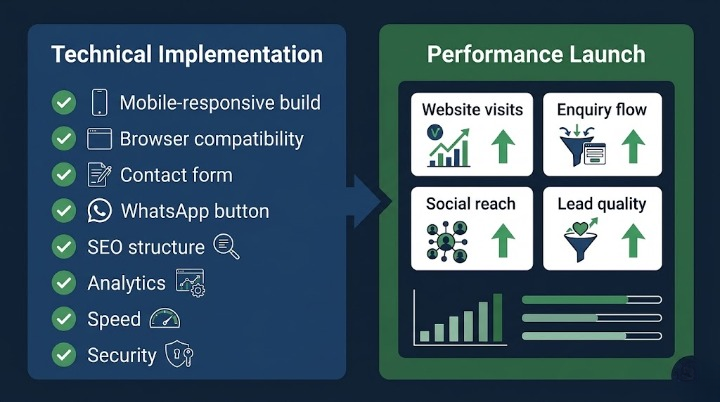
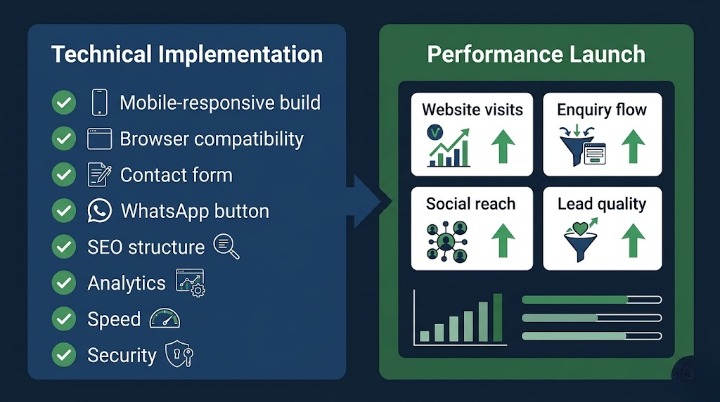
For websites, this includes building a solution that performs well across devices, browsers, and screen sizes. A good MSME website must be fast, secure, easy to manage, and aligned with search visibility.
Technical implementation may include:
- Mobile-responsive development
- Browser compatibility checks
- Contact form integration
- WhatsApp and call button setup
- Basic SEO structure
- Speed optimisation
- Security setup
- Analytics integration
For social media, technical implementation includes setting up pages properly, planning publishing systems, monitoring engagement, and ensuring that content goes live in a structured manner.
This is where digital marketing services for small businesses need discipline. Execution cannot be casual. Every detail affects how people experience the brand.
Step 8: Performance Launch
The launch is not the end of onboarding. It is the beginning of performance tracking.
For a website, a performance launch means deploying the site with attention to speed, security, search engine ranking readiness, and user experience. For social media, it means publishing with real-time monitoring and learning from the audience response.
Once your digital assets are live, we monitor:
- Website visits
- Enquiry flow
- Page performance
- Social media reach and engagement
- Lead quality
- User behaviour
- Content response
This helps us understand whether the digital system is doing its job. If something is not working, we refine it. If something is working, we strengthen it.
Why This Process Works for Indian MSMEs
Indian MSMEs often operate with limited time, lean teams, and pressure to see results quickly. This makes structured onboarding even more important.
A manufacturer may not have time to post daily, but still needs a strong digital presence to build credibility. A local business may not need a complex website, but it definitely needs a Google-friendly profile and a clear enquiry path. A service provider may not need every platform, but needs strong authority on LinkedIn or search.
The right process helps decide what matters now and what can wait.
That is the value of structured digital marketing for MSMEs. It helps business owners stop reacting to every trend and start building a digital presence with purpose.
Why Choose Skillwise Solutions?
At Skillwise Solutions, we understand that MSMEs do not need more confusion. They need clarity, structure, and execution that respects their business reality.
Our onboarding process is designed to understand your goals, identify gaps, build the right roadmap, test what works, and execute with consistency. Whether you need social media authority, a stronger website, better digital visibility, or a complete digital foundation, we help you approach growth with a clear plan.
We also bring together businesses, learners, and experts, enabling us to solve real-world digital challenges through practical thinking. For MSME owners, this means smarter execution. For learners, it means exposure to real business problems. For experts, it means a platform to create a measurable impact.
If your business is ready to move from scattered activity to digital clarity, Skillwise Solutions can help you build the right foundation.
Get in touch with us or explore our services to begin your digital onboarding journey with a clear plan.